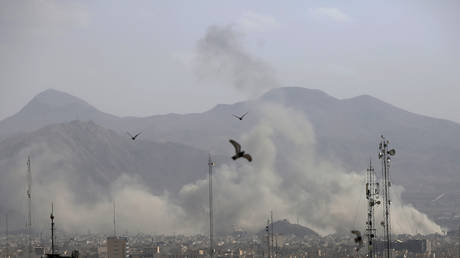
Stop looking for the spark that ignites the next global fire. That fire is already burning, and you are standing inside it while checking the thermometer. The collective panic over whether the current friction between the United States, Israel, and Iran constitutes the opening act of a third world war is a theater of the absurd. It relies on a mid-twentieth-century definition of conflict that no longer applies to the modern state system.
You are stuck in a mental trap. You expect a declaration of war, mass mobilization, and a clear set of battle lines drawn across a map. That is a fantasy designed to make you feel like the world is manageable. It is not. We have entered an era of permanent, low-intensity kinetic engagement—a state of constant, managed conflict that keeps everyone just frightened enough to comply, but never quite terrified enough to organize a systemic revolt.
The Gray Zone Is The New Normal
Historians love the term "total war" because it is tidy. It has a beginning, a middle, and an end. The current volatility in the Middle East is the polar opposite. It is a Gray Zone. In this space, adversaries interact through proxies, cyber-attacks, economic sabotage, and precision strikes that intentionally miss the mark of total escalation.
Think of it as a professional wrestling match where the violence is performative but the consequences for the underlying economic structure are brutal. Iran and Israel are not trying to destroy one another; they are trying to manage the cost of their existence in a regional order that refuses to stabilize. The United States, meanwhile, is attempting to project power into a vacuum it created, using a foreign policy toolkit that was obsolete by the end of the Cold War.
I have spent enough time in risk assessment and intelligence synthesis to know that when the talking heads start shouting about "escalation ladders," they are selling you fear to keep their ratings up. Escalation is not a ladder you climb. It is a room you occupy. The objective for every actor involved is to stay in that room as long as possible without blowing the walls out.
The Myth Of The Thucydides Trap
You hear the academics cite the Thucydides Trap—the idea that an established power and a rising power are destined to clash. It is a lazy argument. It ignores the fact that the primary actors today are not fighting for territory in the way the Spartans and Athenians were. They are fighting for the privilege of setting the rules for the movement of capital and energy.
When Israel executes a targeted strike or Iran directs a proxy militia to harass maritime traffic in the Red Sea, they are not rolling dice on a global conflagration. They are adjusting the price of risk. Every incident is calculated to impact insurance rates, shipping costs, and sovereign debt yields. War has been financialized. If you want to know if a "World War" is coming, stop reading the defense analysts and start looking at the commodities markets and the movement of tanker traffic around the Strait of Hormuz.
The premise that Iran wants a direct, full-scale hot war with the United States is a fabrication used to justify regional arms sales. A direct war would mean the end of the current regime in Tehran, and their survival is the only thing they care about. Similarly, the United States has no appetite for the quagmire that would follow a ground invasion of a nation the size of Iran.
Why You Want A World War
The obsession with the phrase "World War Three" is a psychological defense mechanism. A world war provides a clear narrative. It provides a "good guy" and a "bad guy." It simplifies the messy, incoherent, and often pathetic reality of modern international relations into a story that fits on a movie poster.
Admitting that we are in a state of chaotic, unmanaged decay is too terrifying. So, we hold onto the idea of a "coming war" because it implies that, once the war is over, things will return to normal.
They won’t. The "normal" you are nostalgic for was an anomaly caused by a unipolar moment that ended fifteen years ago. We are now in a multipolar struggle where regional powers can paralyze global logistics with a few drones or a hacked port. That isn't a world war. It is a breakdown of the global system.
How To Read The Situation Without The Hysteria
If you want to understand what is happening, you have to ignore the "breaking news" banners and look at the structural incentives:
- Energy As A Weapon: Watch how energy prices shift after a kinetic event. If the price of oil spikes, the "war" is working exactly as intended by the actors who hold reserves.
- Proxy Persistence: Look for the support lines. If a proxy group is being sustained despite heavy losses, the sponsor is not looking for peace. They are looking to extract a long-term toll on their rival's treasury.
- Internal Distraction: Note the timing of escalations. Every time a domestic government faces an existential crisis—be it an election, a budget failure, or a corruption scandal—the volume of "foreign threats" increases. Foreign policy is the ultimate domestic distraction.
I have seen companies dump millions into "geopolitical risk assessments" that turned out to be nothing more than recycled newspaper headlines. The truth is much colder. Governments are not playing 4D chess. They are playing a frantic game of whack-a-mole, trying to keep their economies afloat while the foundations of the global trade system crack under the weight of accumulated debt and aging populations.
Stop Waiting For The End
The "World War Three" fear-mongering is a tactical distraction to keep you from noticing that your own economic reality is being hollowed out by the same people who are busy funding these regional conflicts. The threat is not a mushroom cloud in a distant country; the threat is the slow, grinding erosion of the stability you take for granted, facilitated by a political class that views foreign policy as a tool for personal retention of power.
Do not try to predict the next "pivotal" moment. There is no such thing. There is only the accumulation of small, brutal adjustments that eventually define an era. By the time you realize you are living through a major historical shift, it will be because you can no longer afford the basic commodities required to survive it.
Stop asking if the war has started. It started years ago, and it is being fought in bank accounts, data centers, and supply chain bottlenecks. The biggest mistake you can make is waiting for a formal invitation to the apocalypse that will never come, while the actual, quiet destruction of the status quo happens right under your nose.
Wake up to the math. The real war is the one being waged against your ability to think clearly about who wins when the world remains in a state of controlled, permanent chaos. If you are waiting for a clear signal, you are already the casualty of the current strategy. Change your focus, follow the money, and stop letting the narrative of global war obscure the reality of systemic collapse.
The next move is yours, but it has nothing to do with following the news. It has everything to do with understanding that you are on your own in a system that is no longer working for you. Stop looking for global leaders to save the world; they are the ones lighting the match.


